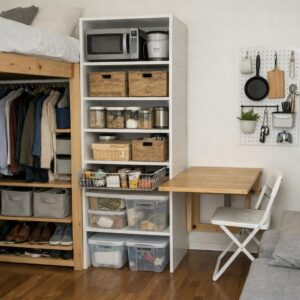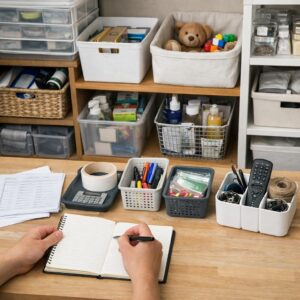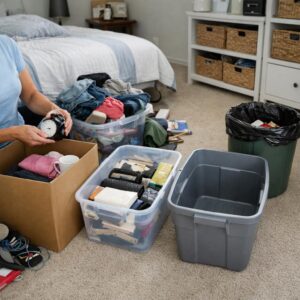
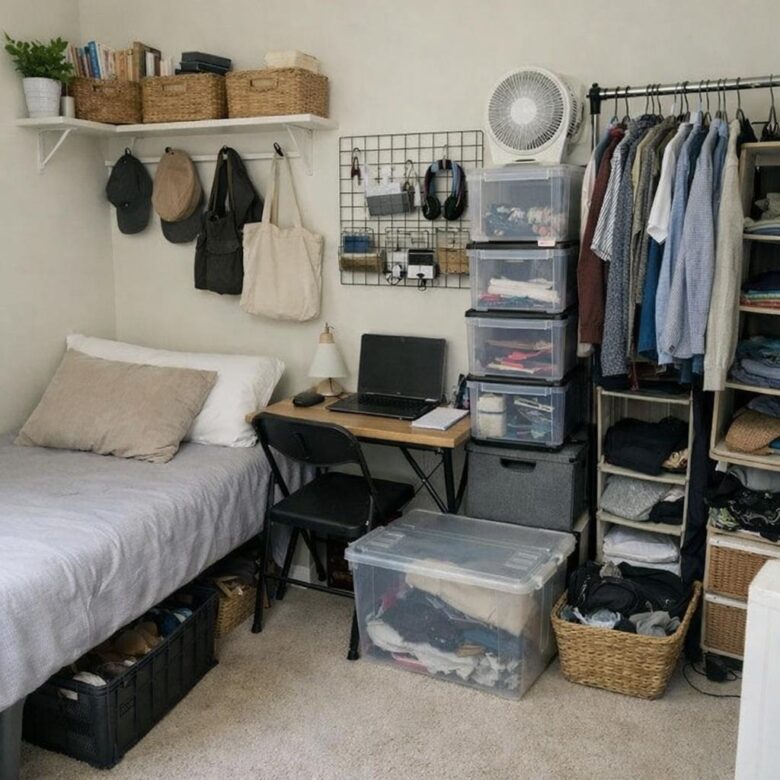
When a small bedroom is difficult to use, buying another cabinet or set of bins can make the problem worse. Start by reducing what the room holds, clearing the main walking path, and giving frequently used items the easiest storage spots. Only then should you consider buying organizers.
You can make meaningful changes with boxes you already own, a tape measure, a few hooks, and a better furniture arrangement. The goal is not to hide every possession. It is to make the bed, closet, drawers, and door easy to use without moving something else first.
Start with a quick room reset
Before reorganizing, remove rubbish, dishes, laundry, and anything that belongs elsewhere in the home. Clear the floor and the top of the bed so you have space to sort. Do not empty the entire closet at once unless you have enough time to finish; a category-by-category approach is easier to manage.
Work through clothes, shoes, bedding, paperwork, electronics, and decorative items separately. For each item, decide whether to keep it in the bedroom, relocate it, donate it, or discard it.
- Daily-use items: Keep these within easy reach, ideally between knee and shoulder height.
- Occasional items: Place them on upper closet shelves, at the back of a drawer, or under the bed.
- Seasonal items: Store them in labeled containers or move them outside the bedroom if another suitable space is available.
- Unused items: Remove them instead of buying storage to accommodate them.
If you are short on time, concentrate on the floor, bedside area, and clothing storage first. These zones tend to affect everyday use more than a perfectly arranged shelf of keepsakes.
Measure before moving furniture or buying bins
Measure the bed, dresser, closet, door swing, available wall sections, and the clearance beneath the bed. Check how far drawers extend when fully open. A dresser may fit between two walls but still be impractical if its drawers block the walkway.
Sketch the room on paper and mark doors, windows, outlets, radiators, and fixed wardrobes. You can also place removable tape on the floor to represent a proposed furniture position. This lets you check the walking route before moving anything heavy.
Protect the main path through the room
Prioritize unobstructed access from the door to the bed and closet. Avoid layouts that require you to squeeze past a dresser corner or move a chair whenever you open a wardrobe. If possible, keep tall furniture away from windows so it does not reduce natural light.
Do not assume every piece belongs against a different wall. In some rooms, placing the bed in a corner creates useful open floor space. In others, access from both sides is more important, especially when two people share the bed. Choose the arrangement that supports how the room is actually used.
Use the closet more efficiently
A closet often contains unused space above the rail, below short garments, or behind loosely stacked clothes. Begin by grouping similar items and returning only what fits comfortably.
- Use matching hanger widths: Slim hangers can reduce crowding, but there is no need to replace functional hangers all at once.
- Add a second rail selectively: A tension or hanging rail can work below shirts and jackets. It is less useful for long dresses and coats.
- Contain folded items: Open boxes or baskets can keep scarves, workout clothes, or small bags from spreading across a shelf.
- Use the upper shelf: Reserve harder-to-reach space for out-of-season clothing, spare bedding, or other occasional items.
- Keep the floor manageable: A short row of shoes or one laundry basket is easier to access than several unstable stacks.
Labels are helpful when containers are opaque or stored overhead. Broad labels such as winter accessories or spare bedding are usually easier to maintain than a complicated system with many small categories.
Treat under-bed space as a storage zone, not a hiding place
Under-bed storage suits items that are useful but not needed every day, including seasonal clothes, extra sheets, and infrequently used bags. Measure the lowest part of the bed frame before choosing containers, and account for handles, lids, or wheels.
Use lidded containers where dust is a concern. Shallow cardboard boxes can be a temporary no-cost option in a dry room, while sturdy containers may be worthwhile for long-term use. Avoid loose piles, which are difficult to clean around and easy to forget.
Vacuum bags can reduce the volume of bulky synthetic bedding, but prolonged compression may leave some fillings misshapen. Delicate fabrics and items that need airflow are better stored clean, dry, and loosely folded.
Move small items off furniture surfaces
Hooks and narrow shelves can replace some of the storage normally provided by a large nightstand or dresser. Use them for lightweight, frequently handled items such as headphones, a dressing gown, jewelry, or a small bag.
Renters can consider removable hooks or over-door organizers, subject to the rental agreement and the manufacturer’s surface and weight guidance. Adhesive products can still damage weak paint or wallpaper, so test an inconspicuous area first. In an owned home, securely installed hooks and shelves may hold more, but they must use fixings appropriate for the wall and intended load.
Do not fill every wall simply because space is available. A few organized items are easier to use and visually quieter than a dense arrangement of open shelves.
Replace bulky furniture only when necessary
Before removing a nightstand or dresser, identify the job it performs. Then look for a smaller way to meet that need.
| Current problem | Lower-cost alternative |
|---|---|
| A wide nightstand crowds the bed | Use a small stool, narrow shelf, or existing wall ledge |
| A chair collects worn clothes | Add two hooks or designate part of a laundry basket |
| A dresser holds rarely worn clothing | Edit the clothes before replacing the dresser |
| A desk is used only occasionally | Use a compact table elsewhere or clear one end of an existing surface |
| Small accessories cover surfaces | Group them in a tray, drawer box, or hanging organizer |
If the bedroom also serves as a home office, keep work supplies in one defined area rather than distributing them around the room. A portable box for chargers, notebooks, and stationery can turn a small table back into a bedside or personal surface after work. More ideas are available in this guide to setting up a home office in a small space.
Make the organization easy to maintain
A small bedroom can become cluttered quickly because there are few spare surfaces. Build a short reset around the actions that matter most: put clothes in the closet or laundry basket, return items from the bedside area, clear the floor, and remove cups or paperwork.
Leave a little empty space in drawers, on shelves, and under hanging clothes. Storage packed to capacity is difficult to use and tends to spill onto nearby surfaces. If a category no longer fits its assigned area, edit it before adding another container.
The most useful small-bedroom system is one that keeps daily items accessible and walking routes clear. Decluttering and rearranging cost nothing, while a few carefully chosen hooks, boxes, or under-bed containers can address the gaps that remain.

The Anna Leong Editorial Team creates practical guides about home organization, cleaning routines, household care, and productive workspaces. We focus on clear steps, realistic examples, and advice readers can adapt to their own homes.